The multi-volume History of Cartography series attempts a unique approach on maps, examining how their production and consumption reflects society and cultural values through the twentieth century. The first volume, published in 1987, reviewed the significance of mapping in Prehistoric, Ancient, and Medieval times. The final volume of the series is set to be published in 2027. As the series draws to a close, we sat down with Jude Leimer, managing editor and longtime contributor to the series, to discuss the History of Cartography and its significance.
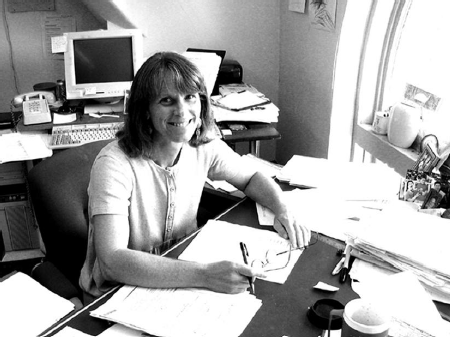
Could you start by telling us a little bit about the History of Cartography project and your involvement in it? How did you initially end up at UW and get involved with this project?
I, like many people, always liked maps, and after completing my undergraduate degree in Geography at the University of Minnesota, I wanted to study them. That was 1979, and what better place than Madison, which offered a degree in Cartography, had the Cartography Lab and the office of the State Cartographer, and boasted a star-studded faculty (Arthur Robinson, Joel Morrison, Phil Muehrcke, and Randy Sale)? The semester after I started, David Woodward joined the department and became my thesis advisor. David later asked me to work on some reference maps for his and Brian Harley’s daring adventure—the History of Cartography Project—and I was hooked. The idea for a worldwide history of mapping was first discussed by David and Brian Harley in 1977, the first grant was received in 1981, and now fifty years later, the History of Cartography (HoC) volumes, prehistory through the twentieth century, will be completed.
Why do you believe that this project is important? What can we learn from the history of cartography?
Maps are a form of human communication, and we can learn a lot by studying the way people see their place in the world across cultures and throughout history. The HoC is innovative in that it has tried to fully consider non-Western traditions, and it has never focused on “famous firsts” or the idea that mapping progressed from less to more “accurate.” It was concerned with the social, political, religious, and cultural contexts of mapping—who made the map, why and how was it made, what was it used for? Putting maps into their social context expanded the definition of map and opened its study to a new and wide range of literature and scholarship.
The History of Cartography has been described as “the most ambitious overview of map making ever undertaken” (Edward Rothstein, NYT). How has the collaborative aspect of this project worked? Has it changed over the years?
The collaborative aspect of the volumes has been essential but challenging. No individual could possibly have written any one of the volumes, and David and Brian (and those who followed after their deaths) could not possibly have edited them alone. They recruited numerous assistant, associate, and co-editors and a large number of contributors from all parts of the world. Although quite successful, author recruitment necessitated unexpectedly time consuming and difficult translations. In addition, unlike the sweeping chapters on overarching topics and regional and national traditions in Volumes 1-3, Volumes 4–6 were prepared in an encyclopedic format. This was a huge challenge to authors—asking them to write shorter essays in a completely new and frankly difficult to understand, complex, and interdependent hierarchical format—but they did it. It “took a village” of several hundred patient and committed authors willing to improve and clarify their contributions to complete each of the HoC volumes.
What has been the most enjoyable part of your involvement with the History of Cartography?
I have loved reading and learning about the history of cartography for the last 40+ years, but the people involved are what have made it most enjoyable. This includes the staff in Madison, the home office of the Project, especially the many many graduate student project assistants we have had and Beth Freundlich, who has co-managed the office for the last 30 years. Perhaps most rewarding has been meeting, working with, and forming close friendships with many HoC editors and authors, and I have also been fortunate to attend thirteen International Conferences on the History of Cartography in cities all over the world.
What are your hopes for the legacy of this project?
Volume 5 is in production (scheduled for 2027 publication). This will complete the History of Cartography series and the incredibly audacious project undertaken by David and Brian. The authors and editors of the completed HoC know that there are innumerable gaps, uneven coverage, and some now outdated material. But the HoC was always intended to be a jumping off point, not a final statement. Further work has already been done, and hopefully the volumes will continue to stimulate new scholarship.