Associate Professor Christian Andresen’s interdisciplinary Earth Sense Lab focuses on the impacts of climate change on land-atmosphere carbon dynamics. For Geography graduate students in the lab, this means traveling to Alaska to study local permafrost thaw and tundra ponds. We talked to two current graduate students in the lab, Katie and Genevieve, about their recent fieldwork trips to Alaska.
Katie, Carbon, and Permafrost Thaw
Katie Braun, a PhD student here in the Department of Geography, spent around three weeks during summer 2025 in northern Alaska. She was joined in field work by four faculty members of varying universities, including Andresen, three other graduate students from varying universities, and a community college professor paired with the group via the National Science Foundation.
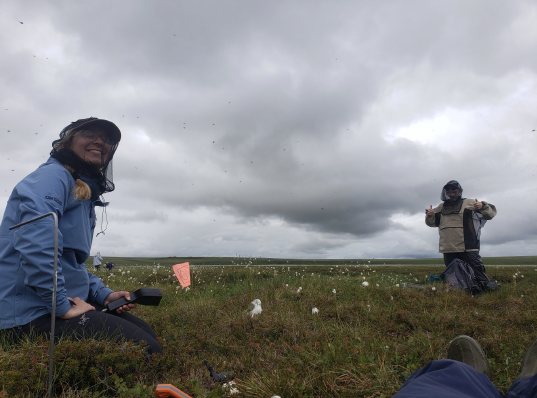
This group spent their time measuring carbon fluxes, flying drones to collect photographs and thermal images of permafrost ponds, and collecting information on plants and soil samples to be taken back to the lab and studied.
There, these measurements will be linked back to historical drone imagery and satellite image record of the area to see how its permafrost ponds have changed over time. This information will be used to help determine whether there is a correlation between the places that have thawed most recently and the carbon communities’ hot spots.
While northern Alaska was beautiful, the fieldwork trip certainly wasn’t a luxurious vacation for the group. The students and faculty were joined by swarms of mosquitos in their travel, and the research group spent their nights camped out on a nearby plateau, hiking themselves and their heavy equipment in and out of the field site every day.
Genevieve, Tundra Ponds, and the Local Community
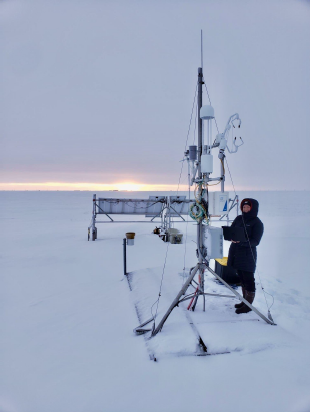
Genevieve Kell, a Masters student in the Department, just returned from Utqiaġvik, Alaska with Andresen in November 2025. In Utqiaġvik, they spent much of their time preparing their equipment and fieldsite for the Alaskan wintertime. This included taking down remaining research equipment and packaging it to be sent back to Madison during the colder months. Genevieve relied on snowmobiles with attached sleds to move equipment from the field site to storage to optimize the limited Alaskan winter daylight hours.
Genevieve most fondly recalls her opportunity to present an overview of the lab’s research with members of the local community. This included information on how tundra ponds in the area have changed in size and composition, determined by the lab’s use of drones, satellite imagery, and ground-based measurements like water temperature and depth. Genevieve also got the opportunity to share her preliminary work mapping carbon “hotspots” within pond systems, done using data from an eddy covariance flux tower.
During this time, Genevieve got the opportunity to hear directly from local residents about how these changes in pond morphology have affected them on a personal basis. Genevieve said this experience added an additional sense of meaning to the fieldwork for her. “Being able to see the ecosystem firsthand and engage with the community where the research takes place really adds context and meaning to the numbers,” she said. “It helped me better understand how our measurements translate to real landscape changes.”