by guest author Natalie Correa
Between August 24th–29, I participated in Redrawing Spaces, a critical cartography summer school program held in Hamburg, Germany organized by Katrin Singer, Paul Schweizer, Boris Michel, Martina Neuburger, and Reike Lenz and the working groups Kritische Geographien Globaler Ungleichheiten at Hamburg University, Digital Geography at Martin Luther University-Halle, and Orango Tango. The program brought together over 20 participants based across numerous countries from different academic disciplines, including various geographic disciplines, architecture, and artistic backgrounds, to name a few. The organizers of Redrawing Spaces aimed to create a space to introduce, discuss, and explore critical cartography through structured content days, guided activities, and smaller group work that provided us with the opportunity to practice critical cartography towards the site of Hamburg, Germany.
Mapping Across Hamburg
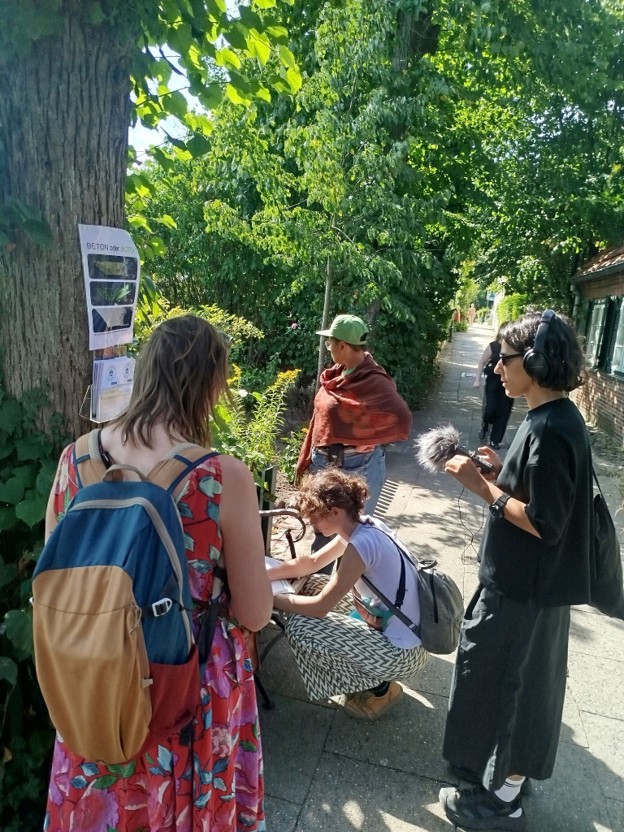
The first day of the program focused on introductions to each other and to the city of Hamburg through a mapping exercise where small groups were given a stack of envelopes whose colors correspond to different points on a map. Groups chose what points to go to and upon arrival to the site, would open the envelope for a brief explanation of the site and a prompt for “deeper mapping” or thinking about the place we were in. I really enjoyed this activity as a way to guide people through and contextualize a space alongside curiosity and adventure. This day ended with a boat tour of the harbour where the tour guide critiqued the past and present state of different parts of Hamburg, situated in the context of Hamburg as a port city.
The next three days were themed around three overarching questions, respectively: what is critique, what are ethics, and what is creativity? A reading was assigned for each day, with additional readings to supplement thinking towards the questions. Each day began with a discussive component where we would discuss pieces of the text and how they related to our own practice or research. Some ways of guiding the discussion included the organizers pulling quotes and proposing questions either to the whole group, for one-on-one discussion, or on cards that could be chosen within smaller group discussions. The second half of these days involved us gathering in predetermined small groups with a mentor where we honed on a topic to explore through a critical cartographic lens.
Group Walks & Work
My group, led by Mariasole Pepa and comprised of Amber De Saeger, Guilia Zambotto, and Sofía Roncancio, explored walking as a critical and creative practice. With the guidance of Katrin Singer, we did two walking tours: one focused on the presence of colonialism by the harbour, as present through colonizer names attached to places, and the second focused on the coloniality of nature by the Elbstrand beach that sits across from a nearby container ship dock, ending at Jenischpark. We each chose to document our thoughts, observations, and curiosities in different ways alongside the walking. This included photography and field sketching (two I chose to do the most), mental/sketch mapping, audio recording, and general notetaking. On the fourth (what is creativity?) and fifth day (presentation day), the groups were encouraged to create something reflective of the conversations we had and the observations made of Hamburg as a place.
Creating a Tangible Map
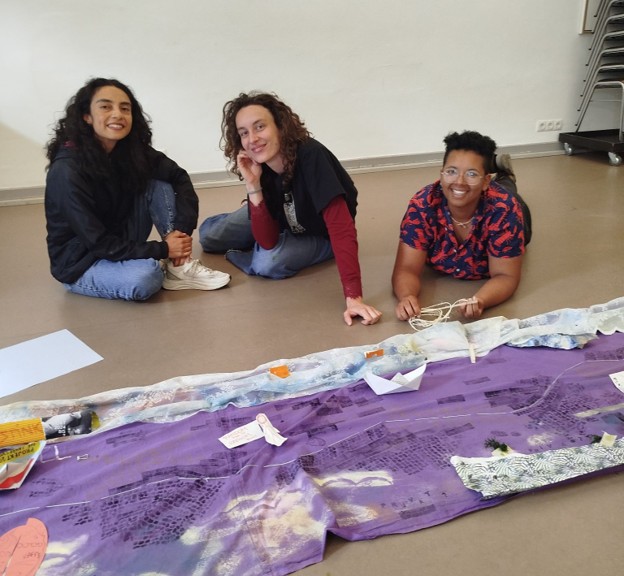
Within my group, we compiled our experiences with the space into a large tangible fabric map (about 15x3ft) alongside a video of clips from our walks, underscored by isolated sound bites of the waves, loud boats moving through the harbor, and calm bells jingling in the wind. Our intention for our project was to embody what it felt like to walk through and experience Hamburg, revealing some of the contradictions we found in the space alongside highlighting the overall cacophonic feeling that we felt at times. The map was made using a mixed-media approach, using linocut printing, spray paint, sewn on features, marker, and collaged magazines. Overall, we sought to create a map using texture and patterns that could bring you into the experience of Hamburg. Other groups similarly created projects that were interactive, immersive, and/or focused on embodied representations of specific stories related to the space they mapped.
This summer school was an amazing experience to experimentally explore a space through the lens of critical cartography. After this program, I am excited to apply similar pedagogical approaches within my own teaching and practice moving forward.