Throughout Science Hall, faculty, staff, and professors are filtering through possessions, packaging materials, and preparing for a big move.
Science Hall will soon undergo renovations. The Geography department, which has called Science Hall its home since the department was established in 1928, will temporarily move to the Computer Sciences building located at 1210 W Dayton Street. We sat down and talked with Joe Mason of the geomorphology and soils lab, Jack Williams of the Williams Paleovegetation Lab, Jaime Martindale of the Robinson Map Library, and State Cartographer Howard Veregin to discuss the process and intricacies of what it takes to move a department that has been in the same place for nearly a century.
The Robinson Map Library Moves Over Spring Break
The Robinson Map Library was the first space to move—and it was no small task.
The Map Library’s global cartographic research collection contains over 500,000 items in total. That’s 300,000 maps, 260,000 historic aerial photos, and a variety of books, atlases, and globes. Map & Geospatial Data Librarian Jaime Martindale spent hours documenting, inventorying, and strategizing how to safely get the collection to its new spaces. Martindale described the efforts made to document “every single drawer, cabinet, shelf, box, package, etc. in a detailed spreadsheet.” This process was done so elaborately, taking the time to record the content details down to individual drawers, that, if needed, she could now “re-label every map case by call number and area.”
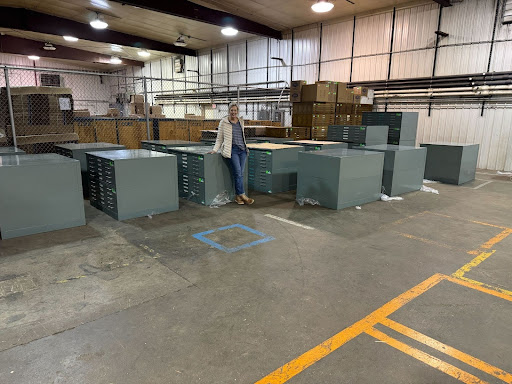
Over spring break, about 90% of the library’s print map collection was moved off-site to a storage warehouse where it will remain for the duration of the renovation. During this time, the library will lean on digital collections and resources from other academic libraries. Its historic aerial imagery collection will remain on campus and accessible to researchers.
One extra interesting part of moving the Map Library? Figuring out how to safely move 23 differently sized globes. “We bubble wrapped each one, then determined how many would fit safely in boxes of varying sizes,” Martindale explains.
Geography Labs Balance Research and Relocation
Of course, geography is about more than just maps. Several departmental lab spaces will also move, among them Joe Mason’s geomorphology and soils lab and Jack Williams’ Williams Paleovegetation Lab. These labs will be temporarily relocated to the Medical Sciences Center at 1300 University Avenue.
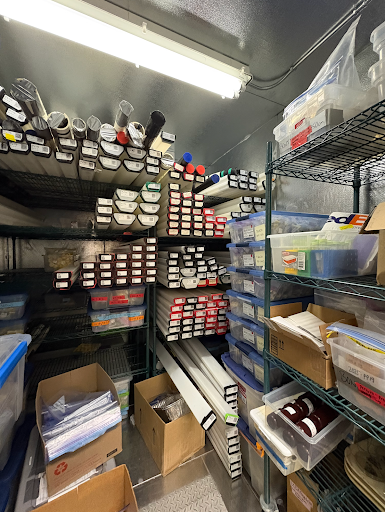
Moving a lab presents unique challenges in the preparation and packaging of microscopes, chemicals, and other sensitive equipment. It also means performing a complex balancing act—packaging lab materials for the move on time while keeping labs functional for as long as possible. As Jack Williams puts it, this means “packing up all the non essentials” like books, papers, and personal items, while leaving essential lab equipment like microscopes and chemical supplies unpacked and functional for as long as possible.
For Joe Mason, decluttering lab spaces has been a significant part of the move-out process. Materials have accumulated across generations of labs, including a room in the basement that stored soil samples for upwards of 40 years. What to keep and what can be safely disposed of has been a point of frequent discussion. “There’s lots of glassware that was purchased for specific kinds of analysis that we don’t do anymore,” Mason explained as one example. “And so you never want to throw that stuff away if you’ve got a place for it, maybe you’ll use it sometime in the future, but now we have to make decisions.”
Some of the challenges have been unexpected. The Williams Lab faced one of those challenges during the room selection process.
The Medical Sciences Center has been used by various UW-Madison labs over the years—and some of those labs have used radiocarbon tracers to conduct their research. That can result in elevated radiocarbon levels, at amounts not dangerous to human health but still high enough to damage the highly sensitive instruments that are used to detect small levels of radiocarbon in ancient sediments. To ensure the Paleovegetation Lab could operate in its new space, more sensitive radiocarbon testing was required than what the Radiation Safety office typically conducts. The lab ultimately had to be relocated to an alternative space on a different floor, slightly separate from other Geography labs in the building.
Cartographers Pack Up & Purge
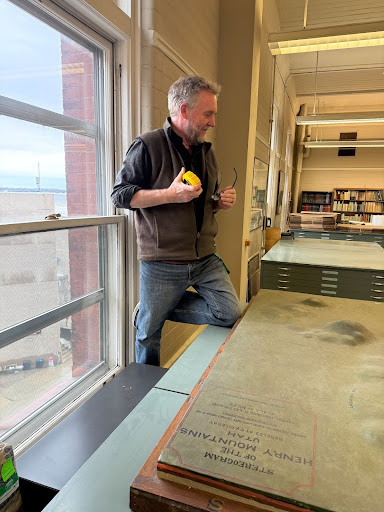
The State Cartographer’s Office faced similar challenges as they decluttered 52 years’ worth of documents, some of which dated from before the office was created in 1974. State Cartographer Howard Veregin discovered historical records dating back to the 1950s and 1960s, old USGS topographic maps, and historic Wisconsin Geographic Names Council (the body in charge of naming lakes, rivers, and more) records dating back to the 1930s.
These historical documents will all be preserved, but deciding what does and does not make the cut to move to Computer Sciences has taken up much of the office’s time this year. “It wasn’t just physically going through things and deciding what needs to be kept and what needs to be thrown out, but planning where we’re going to put stuff when we go over there,” Veregin noted, explaining that the SCO spaces in Computer Sciences will be smaller. “It’s been a long, complicated process of trying to figure out the logistics of, you know, where things go and whether they’ll fit.”
Similarly, the UW Cartography Lab had many historical items to sort through, despite having already moved to a new space within Science Hall about two years ago. During one recent packing session, Professors Rob Roth and Bill Limpisathian and Creative Director Alicia Cowart found a number of historic tools of the trade, including plastic films (mylars), scribing tools, and even a (once radioactive) static eliminator!
Looking Ahead
Despite the complex decluttering and moving process, the Geography Department looks forward to the many opportunities that come along with the renovation of Science Hall. Faculty, staff, and students will get to explore a new space and learn its history.
And of course, we look forward to returning to our home once the renovation is complete in 2029. With new work and study spaces, modernized labs, and more, the new Science Hall will be an incredible home for our department for a long time to come.