Congratulations to UW–Madison Department of Geography Professor Qunying Huang for being a recipient of the American Association of Geographers (AAG) Fellows award! This award is presented to geographers to honor their significant contributions to the advancement of the field of geography. To learn more about her work and what this recognition means, we spoke with Professor Huang about her career, research, and teaching experience:
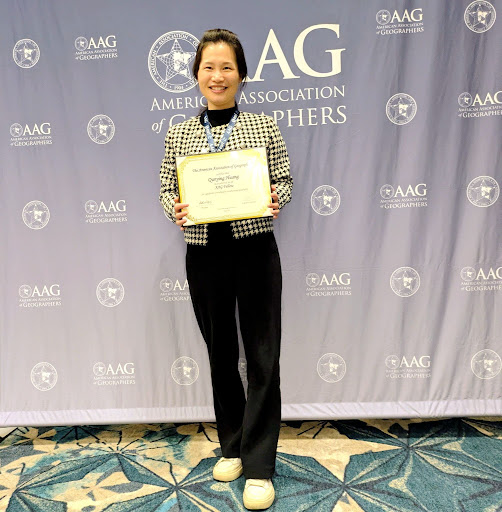
What does being named an AAG Fellow mean to you? How has your involvement in AAG shaped your career?
Being named an AAG Fellow is both a meaningful recognition and a moment of reflection. It represents the collaborative efforts of my students, colleagues, and mentors who have shaped my work. I am deeply grateful for their support and humbled by this recognition. My involvement with the AAG began during my graduate studies with the AAG Cyberinfrastructure Specialty Group, where I served in multiple leadership roles from student board member to Chair. These experiences have played a central role in my professional development by contributing to community building, outreach, and student engagement, while also shaping my research identity and sense of belonging. I have been an active participant in AAG annual meetings, regularly organizing and chairing sessions related to my research. These activities have kept me connected to scholars in my field, strengthened collaborations, and supported engagement with evolving conversations in geography and GIScience. Through conferences and professional opportunities, such as leadership roles, service activities, scholarships, student competitions, and job postings shared via AAG platforms, AAG has helped me stay connected to the field while also offering avenues to contribute to its growth and evolution.
How would you explain your research regarding geospatial big data and GeoAI and its importance to the advancement of geography to someone outside of the discipline?
At its core, my research focuses on using large-scale geographic data and artificial intelligence (AI) to better understand patterns and processes on Earth. In simple terms, we now have vast amounts of location-based data, from satellites, ground sensors, and everyday technologies, and GeoAI helps us analyze this information in ways that were not previously possible. This allows us to detect patterns, predict changes, and support decision-making in areas such as disaster response, environmental monitoring, sustainable agriculture, and urban planning. For geography, this represents a major advancement because it enhances our ability to study complex spatial systems with greater precision, scale, and timeliness.
What role do geospatial technologies play in making inequalities known and mitigated?
Geospatial technologies play a critical role in both revealing and addressing inequalities. By mapping and analyzing spatial data, we can make visible patterns of disparity that might otherwise remain hidden, such as social segregation, unequal access to resources (e.g., food, education, and healthcare), exposure to environmental risks, and disparities in infrastructure. Beyond pattern detection and visualization, these technologies also support evidence-based decision-making by informing strategies to improve equity and inclusion, identify where interventions are most needed, and evaluate their impact. Importantly, when combined with inclusive data practices and community engagement, geospatial approaches can help ensure that solutions are not only data-driven but also socially responsive and equitable.
How do you make the complex topics of your research accessible to the wide range of students you teach?
At the heart of my research on geospatial data science lies the endless potential for scientific exploration and discovery. In my teaching, I connect complex concepts to real-world examples that students can relate to, while encouraging curiosity-driven discussion and the pursuit of innovative solutions to pressing societal challenges. I design course materials and assessments to help students see how their learning can be applied to global issues such as natural hazards, public health, poverty, and inequality. Through open-ended tasks and optional bonus questions, I aim to foster curiosity, empathy, and a sense of social responsibility. Rather than beginning with technical details, I emphasize the “why” behind the methods—why a problem matters and how analytical tools can help address it. I also prioritize hands-on learning, giving students opportunities to work directly with data and explore questions that interest them. By breaking down complex ideas into intuitive steps, encouraging discussion, and cultivating an inclusive learning environment, I strive to make these topics accessible to all students. Ultimately, my goal is to build students’ confidence in engaging with complex material while helping them recognize its relevance to broader societal challenges.
To view the official list of this year’s AAG Awardees, as well as the AAG Fellows Announcement, visit the article here.