All lectures are presented fully online via Zoom every Friday at 3:30 PM. The link to join the meeting is https://go.wisc.edu/l880yf except when otherwise indicated. Alumni, friends and the public are always invited to attend.
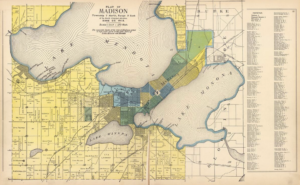
February 27th- Beyond 1862: Indigenous Lands Dispossession in Wisconsin
Panel participants: Ruth Goldstein, Caroline Gottschalk, Hilary Hunt, Kasey Keeler, and Joseph Mason
In 2020, High Country News published Land Grab Universities, an article outlining the relationship between the Morrill Act of 1862—used to fund land-grant universities—to Indigenous land dispossession. In the wake of this article, a group of scholars at UW gathered to investigate the university’s own relationship to dispossession, and the broader, overlapping processes of dispossession within the state. Following years of research, they published a series of educational modules: Indigenous Lands Dispossession in Wisconsin. Please join us for a panel discussion with the team behind the modules, who will describe the project, their process, and discuss the challenges of teaching and researching dispossession.
The panel also serves as the introduction to the 12th Annual Cartography Lab Design Challenge, Visualizing Dispossession, Envisioning Land Back, which will take place the next day. Registration for the design challenge is closed.
*This event will not be livestreamed*

March 20th –The climate and weather of rivers: characterizing channel dynamics across scales
Assistant Professor Claire Masteller, Washington University – St. Louis
Mountain rivers are dynamic systems that both record and respond to changing water and sediment fluxes. Yet distinguishing when a river is stable versus actively adjusting to a new state remains one of the central challenges in geomorphology. This seminar will explore how river channel geometry reflects both the “climate” and the “weather” of river systems—the long-term conditions that shape form and the short-term events that drive river channel change. We first examine how variability in bankfull geometry across diverse U.S. rivers reveals an extractable signature of differing flood frequencies between rivers. Then, we turn to extreme floods, highlighting results from Hurricane Helene in the Blue Ridge Mountains, where rapid satellite-based mapping reveals how pre-flood morphology predicts spatial patterns of channel widening and instability. Together, these studies demonstrate how remote sensing and high-resolution topographic analysis approaches can illuminate the processes that govern mountain river resilience.
April 10th – ¡Autopista Kanpora! Political Economies and Ecologies of Urban Highway Removal in Bilbao
Assistant Professor John Stehlin, UNC-Greensboro
As urban highways built in the mid-20th century age and increasingly limit urban development potential, there is growing interest in replacing them with parks, housing, and surface boulevards in the interest of repairing their harmful social and environmental impacts and implementing a more sustainable model of urbanism. In this presentation, I explore the political-economic and political-ecological dimensions of highway removal and related mitigation projects in the United States and Spain, focusing most directly on the ongoing transformations of several urban highway segments in Bilbao. I argue that highway removal constitutes an uneven “socioecological fix” for the deepening crisis of automobility, suggesting a transformative approach to planning but in practice avoiding confrontation with the structural drivers of car dependence. Nevertheless, I emphasize that highway removal remains a vital arena of urban climate politics.

April 17th – Geographical imaginations and the politics of writing: The work of metaphors in migration research
Professor Patricia Ehrkamp, University of Kentucky
Metaphors describing “floods of migrants” or an “influx of migrant workers” are often used by journalists, politicians, and scholars to describe migration processes. While scholars have critiqued these metaphors as part of popular discourse, the roles that such metaphors play in migration scholarship itself have received less attention. Through analysis of five academic journals, my talk traces the scholarly usage of fluid metaphors in contemporary migration research. This analysis shows that fluid metaphors foster specific geographic imaginaries, which often run counter to otherwise complex and nuanced theorizations of migration and mobility. Based on these findings, I argue for scholarly practices of writing on migration that center precision and care.
April 24th – Uneven Ground: GIScience Approaches to Assessing Vulnerability to Natural Hazards and Informing Emergency Response
Assistant Professor Marcela Suarez, University of New Mexico
Natural disasters are studied and forecasted with increasing precision, yet our ability to anticipate their local impacts and identify the communities most at risk remains limited. This talk presents a number of studies using GIScience methods to address two interconnected questions: how are natural disasters experienced at the local scale, and which populations are most vulnerable to their effects? The first part of the talk examines how social media data can be harnessed to improve situational awareness during disaster events. Drawing on two case studies (the 2013 Colorado Floods and Hurricane Harvey 2017), I discuss the value of spatiotemporal filtering of tweets and present a geographic and content-based prioritization framework for identifying reliable and actionable information from Twitter data. The second part of the talk turns to the question of social vulnerability. Using São Paulo, Brazil, as a case study, we applied a Social Vulnerability Index at the neighborhood level to identify the demographic and infrastructural factors that drive vulnerability to natural hazards in a major Global South city. I conclude by discussing future directions, including remaining challenges in the use of public-contributed data for disaster response and decision-making, as well as future directions for the study of social vulnerability.
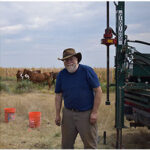
May 1st – Histories of Ordinary Landscapes
Professor Joseph Mason, University of Wisconsin-Madison
My primary research and teaching interest has been the histories of ordinary landscapes, in the Midwest, the Great Plains and elsewhere, those that don’t draw much attention from tourists or many geomorphologists for that matter. I use history broadly here, to include evolution over geologic time as well as the effects of people, both before and after the advent of settler colonialism. I use landscape narrowly to mean the physical, hydrological, and biological features of the land surface, from drumlins to drainage ditches. I will use two or three examples to demonstrate the extraordinary complexity of ordinary landscapes and their histories, how they are always transient, how their past history constrains but does not determine current change, and how, like politics and society, they can change little for long periods and then very rapidly. Along the way I may mention things I’m grateful to have learned from family, friends, students and colleagues, before and after finding my way to academia.