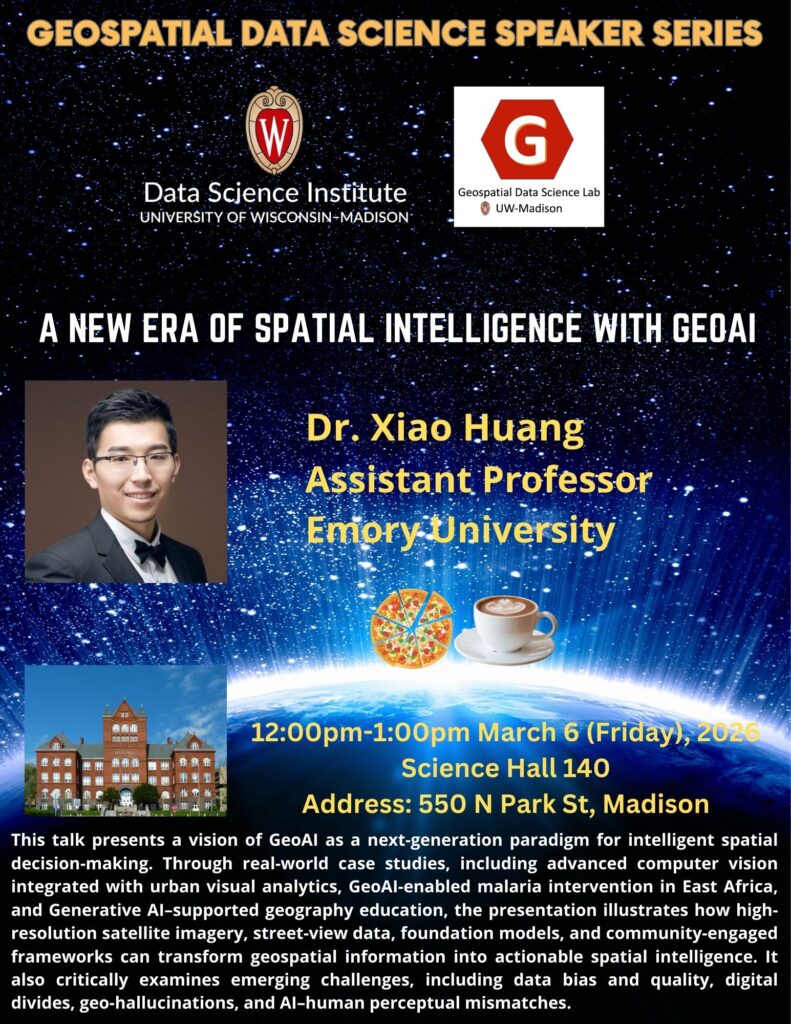
Geospatial Data Science Seminar with Dr. Xiao Huang

Title: A New Era of Spatial Intelligence with GeoAI

Abstract: Drawing on ongoing GeoAI initiatives spanning public health, education, and urban analytics, this talk advances a vision of GeoAI as a next-generation paradigm for intelligent spatial decision-making. Through real-world case studies, including advanced computer vision integrated with urban visual analytics, GeoAI-enabled malaria intervention in East Africa, and Generative AI–supported geography education, the presentation illustrates how high-resolution satellite imagery, street-view data, foundation models, and community-engaged frameworks can transform geospatial information into actionable intelligence. It also critically examines emerging challenges, including data bias and quality, digital divides, geo-hallucinations, and AI–human perceptual mismatches. By coupling theory-aware modeling with responsible cyberinfrastructure and human-in-the-loop design, GeoAI can move beyond automation toward equitable, explainable, and socially grounded spatial decision intelligence in a rapidly evolving world.

Bio: Dr. Xiao Huang is an Assistant Professor in the Department of Environmental Sciences at Emory University. His research spans human–environment interactions, computational social science, urban informatics, GeoAI, and disaster remote sensing, with a strong focus on integrating artificial intelligence and geospatial technologies for societal impact. He has authored more than 240 peer-reviewed journal articles and over 20 book chapters, edited five books, and received more than 7,000 citations on Google Scholar. He is recognized among the World’s Top 2% Scientists by Stanford/Elsevier. Dr. Huang serves as Associate Editor for Computational Urban Science and the Journal of Remote Sensing, and sits on the editorial boards of several leading journals. His work has been featured by Nature News, NASA, NBC, and Fox. He has secured competitive funding from NSF, NASA, the Bill & Melinda Gates Foundation, and the National Academies, and is the recipient of the 2026 AAG Glenda Laws Award.

Calendar link: https://today.wisc.edu/events/view/219143

Personal website: https://envs.emory.edu/people/bios/huang-xiao.html
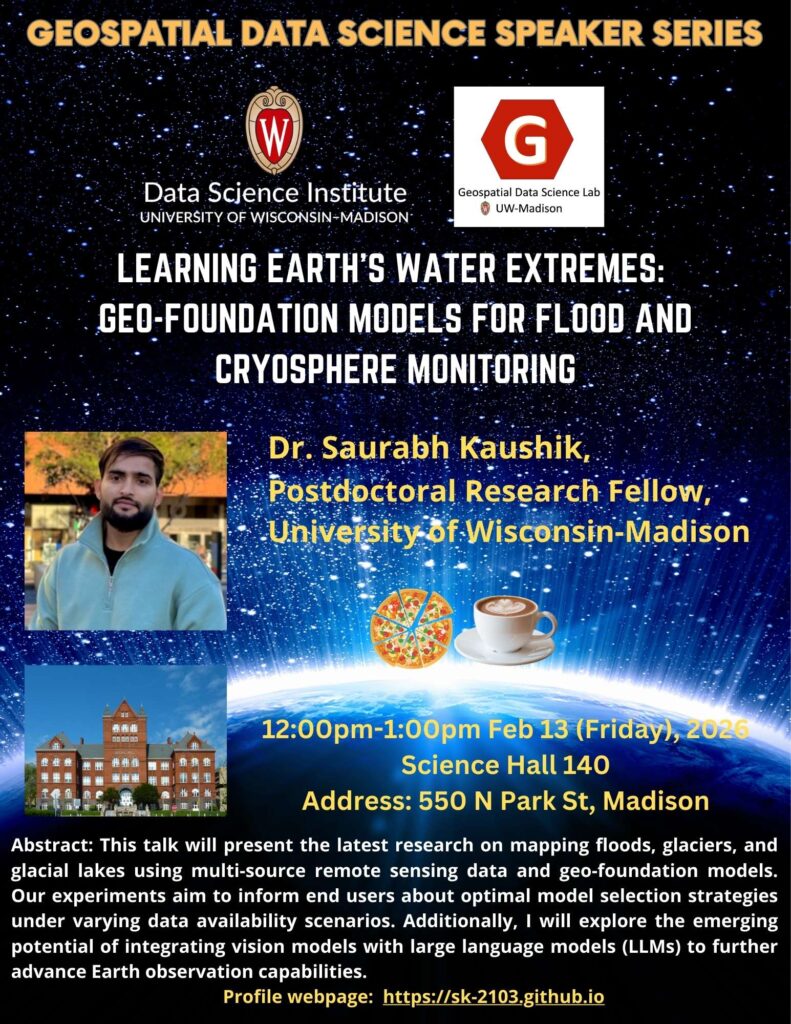
Geospatial Data Science Seminar with Dr. Saurabh Kaushik

Title: Learning Earth’s Water Extremes: Geo-Foundation Models for Flood and Cryosphere Monitoring

Abstract: Monitoring floods, glaciers, and glacial lakes is of broad interest to the scientific community due to their direct impact on human lives, infrastructure, and freshwater availability. Recent advances in remote sensing and deep learning have enabled fast, automated, and reliable mapping of these Earth surface processes. However, the widespread application of deep learning remains limited by the scarcity of labeled data across diverse geographic regions. In this context, recent developments in geo-foundation models offer significant potential to generate robust and transferable maps in data-scarce settings by leveraging large-scale pretraining of model encoders. In this talk, I will present case studies on floods, glaciers, and glacial lakes using multi-source remote sensing data and geo-foundation models. Our experiments aim to inform end users about optimal model selection strategies under varying data availability scenarios. Additionally, I will explore the emerging potential of integrating vision models with large language models to further advance Earth observation capabilities. Overall, these examples demonstrate improved monitoring of two critical Earth system components—the cryosphere and the hydrosphere—and contribute to a better understanding of associated hazards and freshwater resources.

Bio: Dr. Saurabh Kaushik received the Ph.D. degree through a bi-national program between the Academy of Scientific and Innovative Research (AcSIR), India, and the German Aerospace Center (DLR), Germany. He is currently a Postdoctoral Research Associate at the University of Wisconsin-Madison, working on NSF and NASA funded flood mapping project. His research lies at the intersection of computer vision, remote sensing, and Earth observation, with a focus on glacial lakes, floods, glaciers, and water-resource risk assessment. His work aims to develop scalable, reliable Earth observation solutions for long-term environmental monitoring. To learn more about his publications and projects see: https://sk-2103.github.io/