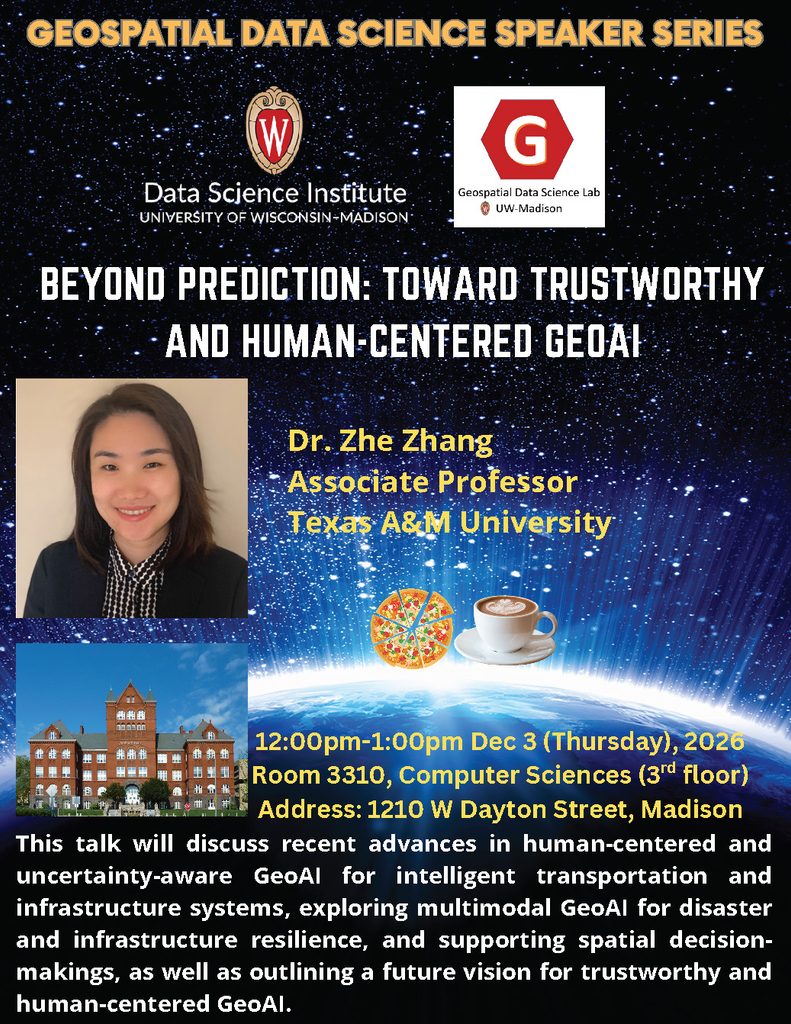
Title: Beyond Prediction: Toward Trustworthy and Human-Centered GeoAI
Abstract: Geospatial Artificial Intelligence (GeoAI) has significantly advanced our ability to model complex spatial and spatiotemporal processes, yet important challenges remain in understanding model uncertainty, integrating heterogeneous information, explaining predictions, and supporting human decision-making. Moving beyond predictive accuracy toward trustworthy and human-centered GeoAI requires approaches that connect computational intelligence with geographic context, domain expertise, and human knowledge. This presentation explores recent advances in GeoAI through three interconnected research directions. First, it examines human-centered, uncertainty-aware GeoAI for intelligent transportation and infrastructure systems, highlighting how spatial uncertainty, model reliability, and human-defined risk preferences can inform decision-making. Second, it explores multimodal GeoAI for disaster and infrastructure resilience, demonstrating how heterogeneous geospatial information, including environmental observations, infrastructure data, imagery, and human-generated information, can be integrated to support risk assessment and spatial decision-making. Finally, this presentation will examine how advances in spatiotemporal modeling and explainable AI can move spatial prediction beyond accuracy alone by helping decision-makers understand the geographic, temporal, and contextual factors that contribute to model outcomes. Building on these research directions, the presentation outlines a future vision for trustworthy and human-centered GeoAI, in which uncertainty communication, causal understanding, interactive visualization, and human expertise are integrated into spatial decision-support systems. This vision aims to move GeoAI beyond automated prediction toward more transparent, context-aware, and collaborative human–AI decision-making for complex geographic challenges.
Bio: Zhe Zhang is an Associate Professor in the Department of Geography at Texas A&M University, with joint appointments in the Department of Electrical and Computer Engineering and the Texas A&M Hazard Reduction and Recovery Center. Zhang has served as Chair of the Cyberinfrastructure Specialty Group of the American Association of Geographers, elected to the Board of Directors of the Cartography and Geographic Information Society, and serves as Chair of the Research Committee of the University Consortium for Geographic Information Science. Her research focuses on participatory GIS, spatial decision support, Human–AI interaction, and trustworthy GeoAI. Building on her early work integrating human judgment, uncertainty, and local knowledge into geographic analysis, she has advanced methods in explainable, causal, and human-in-the-loop GeoAI to make spatiotemporal models more interpretable and useful for spatial decision-making. A complementary research direction examines cyberinfrastructure and high-performance GeoAI, including scalable computing and geospatial data infrastructures for large and complex spatial datasets. Her work has been funded by the NSF, NASA, USDOT, NOAA and the National Geographic Society. Zhang serves as the Co-PI of the Texas A&M FASTER High-Performance Supercomputer and as a Co-Investigator of the Texas A&M ACES Supercomputer. Zhang serves as PI on eight externally funded grants, totaling over $3 million. Zhang has received the Pathways Award from Texas A&M Faculty Affairs, the NSF CAREER Award, the Distinguished Contributions Award from Women in GIS, and the 2022–2024 ISPRS Jack Dangermond Best Paper Award. She serves as an Associate Editor for Computational Urban Science and as an Editorial Board Member for ISPRS International Journal of Geo-Information and Cartography and Geographic Information Science journal.
Calendar link: https://today.wisc.edu/events/view/227943